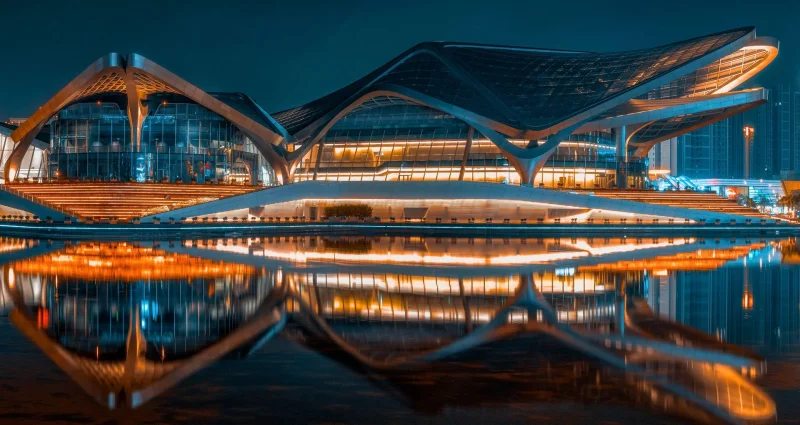
Zhuhai changes character after dark as you move between the sea, the Qianshan River and the newer western districts. Fisher Girl stands against the water on Lovers’ Road, Fuhuali brings street-level restaurants and evening crowds, Xiangshan Bridge reflects across the river, and Jinwan’s cultural buildings turn architecture into a night subject. These places are spread out, so the best plan is one coherent district per evening rather than a rushed citywide checklist.
Choose one of three Zhuhai night routes
For the classic coastal identity, stay around Lovers’ Road, Xianglu Bay and Yeli Island. For restaurants, people and an urban river, combine Fuhuali with Qianshan River. For contemporary architecture and broad reflections, make Jinwan a separate trip. The Guangdong Overseas Chinese Affairs Office’s introduction to Zhuhai describes Lovers’ Road, Fisher Girl and the Sun and Moon Shells as defining parts of the city’s coastal image.
The three areas are not one continuous walking route. Check the map from your accommodation, allow for traffic and decide where the evening should end before setting out. This produces more time at each location and avoids spending the best blue-hour light inside a car.
Use Yeli Island and the Sun and Moon Shells as the coastal anchor
Zhuhai Grand Theatre is popularly known as the Sun and Moon Shells because its two main volumes resemble a large and small shell. The Guangdong Foreign Affairs Office’s theatre profile identifies it as a major cultural landmark whose twin-shell design reflects Zhuhai’s coastal identity. Arriving before complete darkness helps preserve the building, island and water in one frame.
Walk around open public paths rather than assuming the entrance plaza has the only useful angle. A wider view explains the building’s setting; a closer view emphasizes the curved skin and people moving through the space. Decorative colours and event lighting vary, so a particular colour seen in an older photograph should not be treated as a nightly schedule.
Continue along Lovers’ Road to Fisher Girl
The Fisher Girl statue is one of Zhuhai’s longstanding symbols. At night, a tighter photograph can isolate the lit figure against a dark background, while a wider composition includes the rocks and bay. Deyuefang, a traditional-style floating restaurant building near Yeli Island, offers another illuminated silhouette and a deliberate contrast with the modern theatre.
These landmarks are separated along the coast, and Lovers’ Road extends much farther than the portion most visitors photograph. Use public transport or a permitted pickup point if you want to combine them. The waterfront can be slippery after rain or sea spray, so remain behind barriers and follow temporary closures during rough weather.
Photograph Fuhuali at street level
Fuhuali works differently from the open coast. Here the subjects are lit towers, restaurant terraces, planted walkways and people moving between shops. Begin with a wider view that establishes the surrounding buildings, then step closer for a lane, storefront or reflected light. Dinner fits naturally into this part of the evening rather than interrupting a waterfront walk.
Commercial signs and tenants change more quickly than major landmarks, so photographs from earlier visits may not match every current business. That is not a problem: the useful story is the mix of public space, dining and high-rise city light. Avoid photographing diners closely without permission and keep a tripod out of narrow pedestrian routes.
Use Xiangshan Bridge to frame the Qianshan River
Xiangshan Bridge gives Qianshan River a strong geometric subject. A side view shows the illuminated towers and their reflection; a centered view emphasizes the roadway passing through the arches. The same bridge can produce genuinely different photographs when the river, balustrade and arch are used as separate foregrounds.
This is an inland urban waterfront rather than an extension of the Lovers’ Road coast. Treat it as part of the Fuhuali and Qianshan evening, or visit on another night. Water level, wind and haze affect the reflection, while maintenance or special events can alter the lighting. A clear bridge silhouette matters more than reproducing an exact colour.
Make Jinwan a separate architecture evening
Jinwan’s cultural architecture creates a more contemporary night scene, with broad rooflines, glass, amber lighting and a reflecting pool. A symmetrical wide photograph suits the full complex; an angled composition reveals how the roof rises and folds. The surrounding open space also makes it easier to photograph without blocking a busy promenade.
Jinwan is well away from the central eastern seafront. Do not add it as a casual final stop after Yeli Island unless your transport and return are already arranged. Its value is precisely that it provides a different side of Zhuhai: less about a famous seaside statue, more about modern public architecture and planned waterfront space.
Keep night photography simple
On a phone, tap the brightest part of the landmark and lower the exposure slightly. Night mode can help with a still building, but moving people, traffic and leaves may blur during a long capture. Wipe the lens before assuming the camera has failed to focus; humidity and fingerprints are especially visible around small bright lights.
With a camera, build a short sequence: an establishing view, one architectural detail, one reflection, one street scene and one frame with people for scale. A compact tripod is useful only where it leaves the walkway clear. On bridges and beside roads, work from legal pedestrian areas rather than stepping into traffic for a cleaner angle.
Plan transport and the return before staying late
Check current map and transit information on the day you visit because road controls, stop locations and last departures can change. Save the Chinese names 珠海大剧院, 珠海渔女, 富华里, 香山桥 and 金湾艺术中心 in your phone. They are more useful for a driver than an approximate English landmark name. On busy nights, choose a pickup point away from the most crowded curb.
For a wider Pearl River Delta itinerary, Hong Kong’s Victoria Harbour offers a much denser skyline across the estuary. Macao after dark combines historic streets and resort lights, while Guangzhou’s Pearl River is better suited to a river-cruise evening. Zhuhai’s strength is the contrast between sea air, neighborhood streets, river reflections and spacious contemporary architecture.
Photo credits
Photographs are from earlier visits; lighting, tenants and access can change. Images resized for display.
- Jinwan Civic Art Centre illuminated above its reflecting pool: Sunny, Pexels License.
- Elevated view of Zhuhai roads and city lights after dark: Melvin Loi from Macau, Macau, CC BY-SA 2.0.
- Zhuhai Fisher Girl statue illuminated at night: Iswzo, CC BY-SA 4.0.
- Deyuefang lit beside the water on Yeli Island: Popolon, CC BY-SA 3.0.
- Visitors and shop signs along Lotus Road in Zhuhai at night: User: (WT-shared) Uvacavmatt at wts wikivoyage, Public domain.
- A planted restaurant lane in Fuhuali after dark: E2568, CC0.
- Fuhuali towers and pedestrian entrance at night: E2568, CC0.
- Xiangshan Bridge and Qianshan River reflections at night: E2568, CC0.
- Centered view through the illuminated Xiangshan Bridge arches: E2568, CC0.
- Jinwan Civic Art Centre and its reflection at night: Dllu, CC BY-SA 4.0.