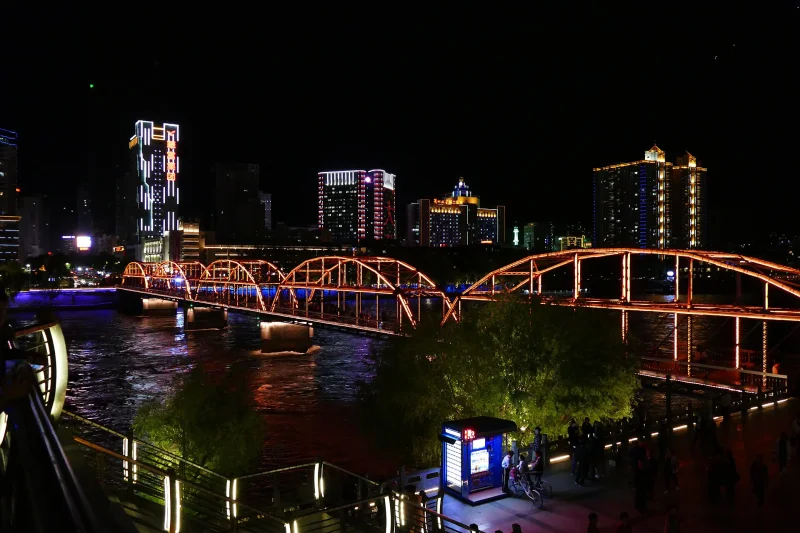
Lanzhou’s night view is different from the coastal and riverfront cities already covered on this site. Here, the Yellow River is not just a background line; it is the main route through the city. Zhongshan Bridge gives the evening walk a historic anchor, the Water Mosque and Xiguan Mosque add architectural variety, and the Lanshan overlook shows how the city stretches through the valley after dark.
This guide focuses on a compact, photo-friendly Lanzhou night route. It is built around the Yellow River corridor, with enough stops to show bridge reflections, riverside landmarks, mosque lighting, and one wider city panorama.
Why Lanzhou Works Well at Night
Lanzhou is a long city shaped by mountains and the Yellow River. That geography changes how the night view feels. Instead of a flat skyline, the lights collect along the river and climb into the valley. From the riverbank, you see bridges, water, slopes, towers, and traffic in the same frame.
This makes Lanzhou a strong contrast to the lower, more humid river routes in places like Fuzhou’s Min River night view. Fuzhou is about island lights and broad urban bridges; Lanzhou feels narrower, warmer, and more defined by the Yellow River itself.
Zhongshan Bridge and the Yellow River
Zhongshan Bridge is the best place to begin. The steel truss shape is easy to recognize, and the warm lighting reflects strongly on the Yellow River when the water is calm. Shoot the bridge from both sides if you have time: the north-bank view gives a fuller relationship between bridge, river, and city lights, while closer angles make the structure feel more dramatic.
Blue hour is useful, but the bridge can also photograph well later because the orange and blue lighting stands out clearly against the dark river. Include part of the riverbank or walkway in some frames so the image does not become only a bridge close-up.
Chengguan Riverfront Angles
The Chengguan District side gives you several variations of Zhongshan Bridge. From some angles, the bridge sits low across the water with high-rise lights behind it. From others, the colored lighting on the steel arches becomes the main subject. These angles are similar enough to feel connected, but different enough to build a useful photo sequence.
If you are only using a phone, focus on the brighter bridge spans and avoid over-dark sections of water. If you are using a camera, a short tripod exposure can capture the river texture and the city lights without turning the bridge into a flat strip of color.
Water Mosque and Xiguan Mosque
The Water Mosque adds a riverside landmark that is not just another bridge view. At night, its lights sit close to the river, while the slopes and surrounding buildings give the scene a layered backdrop. It works best as a wider frame, with water in the foreground and hillside lights behind.
Xiguan Mosque gives the route a more urban architectural stop. Its facade is bright and clean at night, so it can be photographed handheld more easily than the darker river scenes. Together, the two mosque stops help keep the guide from feeling like a single-bridge article.
Lanshan City Overlook
The Lanshan overlook, often associated with the Santai Pavilion area, is the best way to understand the city’s shape after dark. From above, Lanzhou becomes a long river-valley line of lights. The panorama is not about one landmark; it is about the whole city folding between mountains and water.
Use this stop as a separate add-on rather than forcing it into a short riverside walk. It takes more time to reach, but it gives the gallery a wider ending. If you like elevated city-night views, this is closer in purpose to mountain-overlook shots than to the walking routes in Changsha’s Xiang River and Yuelu Mountain guide, though Lanzhou’s valley shape feels much more enclosed.
Suggested Evening Route
Start at Zhongshan Bridge before full darkness. Walk the bridge, photograph it from the riverbank, then continue along the Yellow River for side angles and reflection shots. Add the Water Mosque while you are still near the river, then move toward Xiguan Mosque if you want an urban architectural frame.
If you have a second evening or a longer night, use Lanshan as the wider city-view stop. A tight first-evening route can be Zhongshan Bridge, Water Mosque, and Xiguan Mosque. A fuller route adds Lanshan for the closing panorama.
Best Time and Photo Notes
Autumn and spring are usually the most comfortable seasons for a night walk along the Yellow River. Summer evenings can still work well, but expect more people around the bridge and riverfront. Winter can be clear, though colder near the water.
For photos, avoid relying on only one Zhongshan Bridge angle. The bridge changes depending on whether you frame it from the walkway, the north bank, or farther down the river. Keep a mix of wide river shots, tighter bridge details, and architectural stops so the gallery feels like Lanzhou rather than a repeated bridge study.
Image Credits
Images in this guide are credited to their respective Wikimedia Commons contributors under the license terms listed on each source file page, including Creative Commons licenses where applicable.