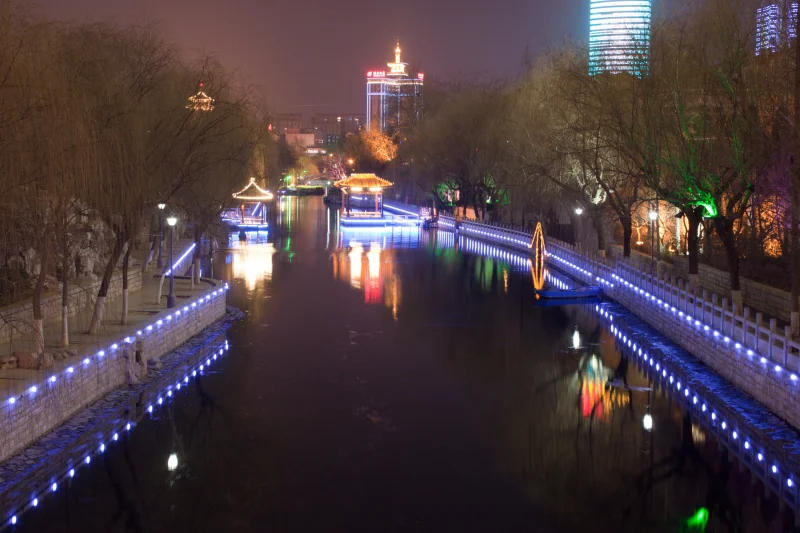
Jinan is not a city that depends on one skyline angle. Its night view is built from water, old urban routes, public squares, and warm historic lighting. Around the city moat, reflections from bridges and riverside lamps soften the center of the city; around Daming Lake, Chao Ran Tower gives the old lake district a bright vertical landmark; and at Quancheng Square, modern lighting opens the route into a broad civic night scene.
This guide focuses on the most practical evening route for first-time visitors: start around the city moat before the sky turns fully black, continue toward Quancheng Square and the central shopping streets, then leave time for Daming Lake and Chao Ran Tower. If you enjoy water reflections, this route feels quieter than the big-river drama in the Hangzhou West Lake night view guide, but it has the same advantage of easy walking and repeated photo stops.
Why Jinan Works Well After Dark
The city’s evening character comes from its spring-water geography. The moat and lake areas keep a lower, more reflective scale than many downtown districts in China, so a good night walk is less about chasing one observatory and more about moving between short scenes. Lantern-like building lights, blue-white riverside railings, wet stone paths after rain, and commercial signs all sit close enough together for a relaxed two-to-three-hour route.
For photographers, the best part is variety. You can frame water reflections along the moat, a broad open square at Quancheng Square, old-style architecture at Daming Lake, and modern commercial streets within the same evening. The result is a gallery that explains Jinan better than a single skyline photo would.
City Moat and Hucheng River Reflections
The city moat area is the best place to begin. Arrive during blue hour if possible, when there is still a little color in the sky and the lights along the water have already switched on. From bridges and riverside paths, look for repeated reflections from railings, small pavilions, and nearby towers. Long-exposure photos work especially well here because the river surface can turn small points of light into continuous color.
This part of Jinan is also useful because it keeps the route flexible. If the weather is clear, stay longer around the water. If the sky is flat or hazy, move sooner toward Quancheng Square, where the open plaza and stronger lighting give you more dependable night shots.
Quancheng Square and the Central Night Route
Quancheng Square gives the walk a very different scale. The space is open, the landmark sculpture is easy to recognize, and the wet ground after rain can create strong reflections. It is a good midpoint between the quieter moat and the brighter commercial streets.
From here, the nearby shopping streets add a more everyday side of Jinan after dark. Guihe Shopping Center and the surrounding blocks are not ancient landmarks, but they show how the city feels when people are out for dinner, shopping, and short evening walks. This contrast is useful: the best Jinan night photos are not only lake towers and riverside lamps, but also the living streets between them.
Daming Lake and Chao Ran Tower
Daming Lake is the strongest historic-looking stop in this route. Chao Ran Tower, especially when lit against a deep blue or black sky, gives the lake district a clear focal point. The tower photographs best from slightly farther back, so leave room in the frame for trees, water, or the surrounding entrance architecture instead of cropping too tightly.
The Daming Lake entrance arch is another useful night subject. It has enough warm light to stand out, and the people moving below it help keep the scene from feeling empty. If you like old-city night routes, this part of Jinan pairs naturally with places such as Kaifeng’s Drum Tower Night Market and city water system, though Jinan feels more lake-and-spring focused than market-first.
Yellow River Phoenix Bridge and Arrival Views
If you have extra time or a car, the Yellow River Phoenix Bridge adds a broader river crossing to the gallery. It is not as central as the moat or Daming Lake, but its long line of bridge lights gives Jinan a larger metropolitan frame. The bridge works best as a separate stop rather than something to force into the same walking loop.
Jinan West Railway Station is also worth noting for travelers arriving by high-speed rail. The glowing station sign is a simple image, but it marks the practical start or end of many trips. Including it in a night-view route helps show how the city’s evening scenes connect from arrival points to central walking areas.
Suggested Evening Plan
Start around the city moat roughly 30 to 45 minutes before full darkness. Walk slowly and shoot from bridges first, then from the riverside path. After that, move toward Quancheng Square for the open plaza and central city lights. Use the commercial streets nearby for dinner or a short rest, then continue to Daming Lake and Chao Ran Tower when the tower lighting is fully visible.
If you want a tighter route, focus on the moat, Quancheng Square, and Daming Lake. If you want a more complete photo set, add the Yellow River Phoenix Bridge as a separate final stop. For another Chinese night route where water reflections dominate the mood, the Guilin Two Rivers and Four Lakes guide is a useful comparison, but Jinan is easier to do as a city-center walk.
Best Time and Practical Notes
Spring and autumn are the easiest seasons for this route, with comfortable evening temperatures and enough pedestrian life to keep the photos lively. Summer can still work well, especially after rain, but expect haze and busier public spaces. In winter, the air may be clearer, though the walk can feel much quieter.
For photography, bring a small tripod only if you are comfortable using it in public spaces. Otherwise, a phone with night mode or a camera with stabilization is enough for most scenes. The moat and Chao Ran Tower reward steady framing; Quancheng Square and the commercial streets are better for quick handheld shots with people in the scene.
Image Credits
Images in this guide are credited to their respective Wikimedia Commons contributors under the license terms listed on each source file page, including Creative Commons, CC0, and public-domain-compatible releases where applicable.