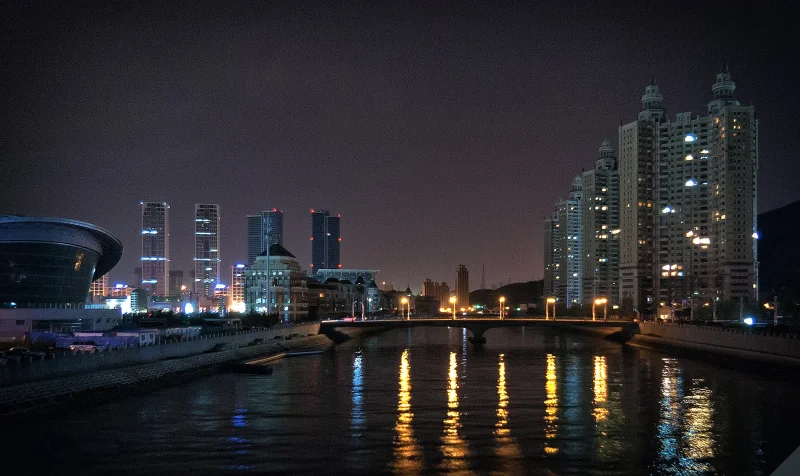
Dalian’s night view has a different rhythm from the river cities of inland China. It is a coastal city, so the strongest scenes usually mix open water, long plaza axes, station lights, port activity, and high-rise reflections. Instead of one compact old-town walk, the best Dalian evening route works as a set of connected photo stops: Xinghai Square for scale, the waterfront for reflections, the railway station for arrival energy, and the port for a stronger sense of the sea.
This guide focuses on practical, photo-friendly Dalian night scenes rather than trying to cover every beach or island. If you have one evening, build the route around Xinghai Square and the central waterfront. If you have more time, add Dalian Port and the station area for a broader picture of how the city looks after dark.
Why Dalian Looks Good at Night
Dalian’s night scenery works because the city has space around its lights. Wide squares, sea-facing roads, bridges, and harbor edges give the skyline room to breathe. That makes it different from the tighter riverfront density in the Tianjin Haihe River guide or the more dramatic hill-and-harbor layering in Hong Kong Victoria Harbour.
The best photos are usually not the brightest ones. Look for reflections on calm water, wet pavement in Xinghai Square, the warm facade of Dalian Railway Station, and the layered lights of ships, terminal buildings, and high-rises around the port. These scenes explain the city’s coastal character more naturally than a single skyline frame.
Xinghai Square and the Wide Coastal Frame
Xinghai Square is the most useful place to begin. The space is large, open, and easy to recognize, with long sightlines toward the bay and bridge lights in the distance. A wide panorama can look very thin on a phone screen, so it helps to shoot several versions: one broad view for context, one tighter frame with people or fountains in the foreground, and one vertical shot if the light beams or towers are active.
Arrive before full darkness if you want a cleaner sky, but stay after the lights have settled. The plaza can feel empty if you crop too high, so include pavement reflections, pedestrians, railings, or the waterline when possible. This gives the scene a better sense of scale.
Waterfront Skyline Reflections
The waterfront skyline is where Dalian starts to feel more intimate. A good night photo here is less about maximum brightness and more about the balance between towers, bridges, and water. When the surface is calm, even a small row of building lights can create strong vertical reflections.
For a first-time visitor, this is the part of the route that most clearly says “coastal city.” The light is softer than a heavy downtown LED district, and the water gives the images a quieter mood. If you like this style of night photography, the coastal contrast with the Qingdao Fushan Bay and Zhanqiao route is worth comparing: Qingdao feels more landmark-and-bay focused, while Dalian spreads its best scenes across plazas, roads, and port edges.
Dalian Railway Station and Arrival Lights
Dalian Railway Station is not just a transport stop. At night, its illuminated facade and busy forecourt create a strong arrival image, especially for travelers entering the city by train. The station works best from the front when the building fills the frame, but an angled view from the plaza can show more movement and surrounding lights.
Use the station as a practical stop if your hotel or route passes through the central area. It also adds variety to the gallery: after water and skyline scenes, the station gives the article a people-and-city rhythm rather than another distant bay view.
Dalian Port and Harbor Views
Dalian Port gives the night route its maritime edge. Passenger ships, terminal lighting, and the city skyline behind the water create a scene that feels working-city rather than purely scenic. This is especially useful if you want photos that distinguish Dalian from inland cities with river promenades.
The port area is not always as simple to walk as a public square, so plan it as a targeted stop rather than a casual wander. Look for safe public viewpoints, keep the camera steady, and do not rely only on the brightest terminal lights. The better frames often include the dark water, a ship deck or railing, and the skyline beyond.
Friendship Memorial Hall and Smaller Night Landmarks
The Kitakyushu City Dalian Friendship Memorial Hall adds a smaller architectural stop to the route. Its lit facade gives a warm, human-scale contrast to the open square and port scenes. It is useful when you want a night photo that is not dominated by high-rises.
Scenes like this are also a reminder that Dalian’s night view is not only about the sea. The city’s historic-style buildings, station area, and civic spaces help break up a route that could otherwise become too skyline-heavy.
Suggested Evening Route
Start at Xinghai Square around sunset or early blue hour. Spend enough time to shoot both the wide plaza and tighter foreground details. Then move toward a waterfront viewpoint for skyline reflections. If your evening is short, stop there and use dinner nearby as the end of the route.
For a fuller photo set, continue to the central station area and finish with Dalian Port or a harbor viewpoint. This makes the article’s route feel complete: open plaza, water reflections, arrival landmark, and working harbor. Allow three to four hours if you are moving between these areas by taxi or metro.
Best Time and Photo Notes
Clear evenings after rain are ideal because Dalian’s plazas and roads can reflect the lights without too much haze. Summer evenings are lively but may be humid; autumn often gives cleaner air and more comfortable walking. Winter can be sharp and windy near the water, so plan shorter outdoor stops.
For photos, a phone with night mode is enough for Xinghai Square and the station. For the waterfront and port, a small tripod or stable railing helps. Avoid overexposing the brightest signs and station facade; preserving the darker water and sky often makes the final image feel more like Dalian.
Image Credits
Images in this guide are credited to their respective Wikimedia Commons contributors under the license terms listed on each source file page, including Creative Commons licenses where applicable.