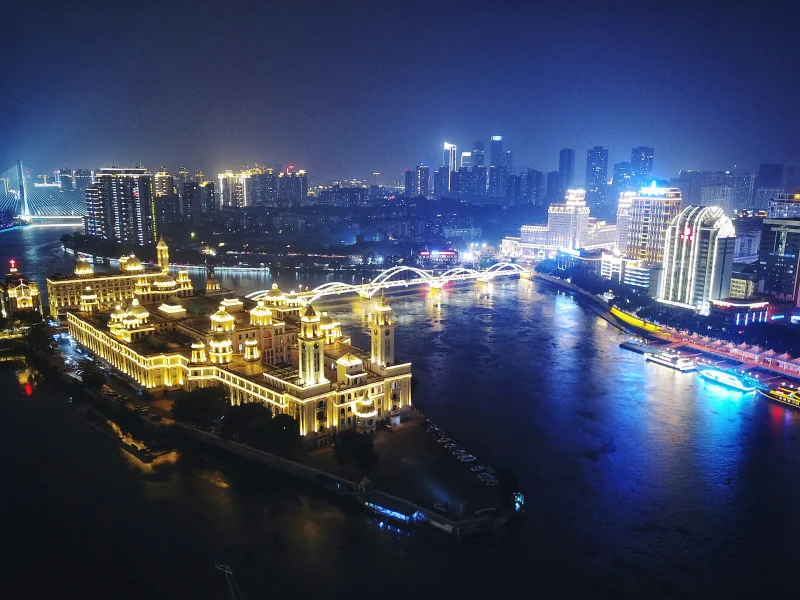
Fuzhou’s night view is built around the Min River. The best evening route moves between water, bridges, island lights, and central-city streets rather than relying on one tower or one skyline viewpoint. Zhongzhou Island gives the route its strongest river image, while Jiefang Bridge, Sanxianzhou Bridge, Taijiang, Wuyi Square, and Wusi Road add the city-center rhythm around it.
This guide is for travelers who want a practical Fuzhou night walk with strong photo stops. It keeps the route focused on places that show the city clearly after dark: river reflections, bridge lines, public-square lighting, and the busier road scenes near the center.
Why Fuzhou Works Well After Dark
Fuzhou has a softer night-view style than China’s biggest skyline cities. The Min River gives the city room for reflections, and the bridges create clear shapes across the water. That makes the best photos feel layered: dark river, lit arches, island buildings, skyline blocks, and traffic moving through the foreground.
If you are comparing Fujian night routes, Fuzhou feels more river-and-bridge focused than the seaside views in the Xiamen Gulangyu and Lujiang night guide. Xiamen leans toward island silhouettes and ferry-side views; Fuzhou is more about the Min River, central bridges, and evening city streets.
Zhongzhou Island and the Min River
Zhongzhou Island is the clearest starting point for a Fuzhou night-view route. Its lit buildings sit directly in the river scene, so you can frame water, architecture, and traffic together without needing a distant observation deck. From nearby bridges or riverfront viewpoints, the island works well as both a wide establishing shot and a tighter reflection photo.
The best time is shortly after the city lights switch on, when the sky still has a little blue left. Later at night, the scene becomes more dramatic, but the dark sky can make the brightest buildings harder to balance. If you are using a phone, tap for the lit island rather than the black water so the highlights do not blow out.
Jiefang Bridge and Sanxianzhou Bridge
Jiefang Bridge is one of the most useful night subjects in central Fuzhou. The arches create a strong shape, and the river reflections make the bridge feel brighter than the surrounding skyline. It is a good place to slow down and shoot several frames, because small changes in angle can change how the arches overlap with the water and buildings behind them.
Sanxianzhou Bridge gives the route a more modern cable-stayed form. Its bright white structure stands out cleanly against the night sky, especially when there is enough dark water below it. Together, Jiefang Bridge and Sanxianzhou Bridge give the article a river-crossing sequence rather than a single landmark stop.
Taijiang Waterfront and Jinshan Bridge Views
The Taijiang side adds the working-city feeling to the route. Road lights, bridge traffic, and towers along the water make the photos more active than a quiet riverside park shot. From the Jinshan Bridge side, the road itself can become part of the image, with scooter movement and streetlights leading toward the skyline.
This section is also useful if the river is windy and reflections are weak. Even when the water is not smooth, the road and building lights still give you a dependable night scene. For another city where riverfront bridges carry much of the evening route, the Ningbo Sanjiangkou and Old Bund guide is a natural comparison.
Wuyi Square and Wusi Road
Wuyi Square changes the pace from river views to public-space lighting. The fountains and plaza lights give the route a civic center stop, and it is easier to photograph handheld than the darker river edges. Include people, pavement, and the fountain line if the square feels too dark around the edges.
Wusi Road gives a more everyday city view: traffic, storefronts, hotel signs, and high-rise facades. It is not as postcard-like as Zhongzhou Island, but it helps explain how Fuzhou feels when people are moving through the center after work. A good guide should show both the scenic river and the streets that connect it.
Riverside Park and a Short Evening Plan
Riverside Park is a good place to end or pause the route. It gives you a wider, calmer view of the Min River and the opposite bank, with enough foreground to avoid a flat skyline-only photo. If you are traveling with family or want an easier walk, this stop is more comfortable than spending the whole evening near road traffic.
A simple plan is to start near Zhongzhou Island, shoot Jiefang Bridge and the surrounding riverfront, continue toward a Taijiang or Jinshan Bridge viewpoint, then use Wuyi Square and Wusi Road as the city-center finish. If you have limited time, focus on Zhongzhou Island, Jiefang Bridge, and Wuyi Square; that gives you water, bridge, and central-city lighting in one compact set.
Best Time and Photo Notes
Clear evenings after rain are ideal because the riverfront lights and roads reflect better. Spring and autumn are the most comfortable seasons for walking; summer evenings can still be lively, but humidity and haze may soften the skyline. In winter, the river area can feel quieter, which is good for steadier photos but less useful if you want active street life.
For photography, a phone with night mode is enough for Wuyi Square, Wusi Road, and the brighter bridge views. For Zhongzhou Island and river reflections, steady your camera on a railing or use a small tripod if conditions allow. Keep the river in the frame, but do not let black water take over the image; the strongest Fuzhou night photos usually balance water, bridge, and skyline together.
Image Credits
Images in this guide are credited to their respective Wikimedia Commons contributors under the license terms listed on each source file page, including Creative Commons and CC0 releases where applicable.