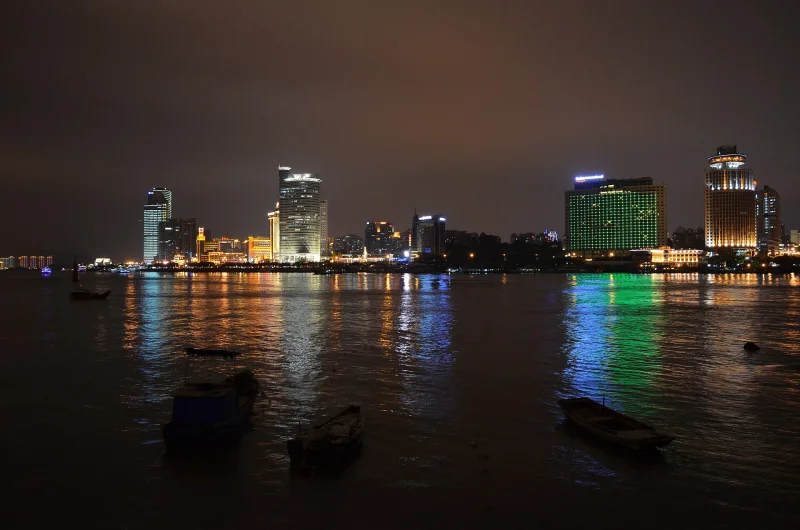
Xiamen works best at night when you treat it as a coastal route rather than a single viewpoint. The strongest first-evening plan is to move between the Lujiang waterfront, the view toward Gulangyu, the ferry-pier area, Yanwu Bridge, and a short street walk around Zhongshan Road. This guide focuses on Xiamen night view photos, realistic walking choices, and the angles that show the city as a harbour-facing, island-linked destination.
Why Xiamen Works After Dark
The night scenery in Xiamen is softer than the vertical skylines of Shanghai or Hong Kong. Water, low island silhouettes, bridge lights, ferry movement, and old commercial streets do much of the work. Gulangyu adds a historic layer, while the mainland waterfront gives you open views across Lujiang Strait and enough space for tripod-style framing when crowds are manageable.
If you want a route with skyline drama, compare it with the Hong Kong Victoria Harbour night view guide. If you prefer a coastal city where public squares, bays, and old piers shape the view, the rhythm is closer to the Qingdao Fushan Bay and Zhanqiao night view route, but with a more island-facing character.
Start With Gulangyu And The Lujiang Waterfront
The classic Xiamen night image is the city seen across the water from or toward Gulangyu. From the mainland side, the island becomes a dark foreground with warm building lights and moving boats. From Gulangyu, the Xiamen skyline and waterfront lights spread across the opposite shore. The view is especially useful for wide photos because the water gives reflections and separates the skyline from the foreground.
Gulangyu is also worth slowing down for because it is not only a photo backdrop. UNESCO lists Kulangsu, the historic international settlement, for its layered architecture and cultural exchange history. That background makes the night walk feel different from a modern commercial waterfront: the streets, gardens, colonial-era facades, and harbour views all sit close together.
Use Yanwu Bridge For A Modern Coastal Angle
Yanwu Bridge gives Xiamen a more contemporary night-view line. Its curve, shore lighting, and nearby beach areas can frame the city with a lower, wider perspective than a tower or observation deck. It is useful when you want bridge lights without losing the coastal setting.
The best time is usually after blue hour, when the bridge lighting is visible but the sky has not gone completely flat. On humid or rainy evenings, distant buildings can soften quickly, so focus on closer bridge details, shoreline lights, and reflections instead of forcing a long skyline shot.
Add Haicang Bridge And Ferry-Pier Views
Haicang Bridge adds a stronger engineering landmark to the route. It is not always the easiest stop to combine with a short walk, but it helps show Xiamen as a bridge-and-bay city rather than only an island destination. If your evening is limited, the ferry-pier area is more convenient because it connects naturally with Gulangyu views, Lujiang cruise activity, and waterfront streets.
The ferry-pier side is also one of the easiest places to make practical night photos. You can catch boats, terminal lights, signs, people moving through the waterfront, and a layered background of city lights. For travellers who do not want a long route, a pier-to-Zhongshan-Road walk can already give a complete Xiamen evening.
Zhongshan Road And Night Market Streets
Zhongshan Road brings the street layer into the guide. After the waterfront views, the pedestrian street and nearby night-market scenes give you signs, shopfronts, food stalls, arcade-style buildings, and a denser human scale. This part is less about a postcard skyline and more about how Xiamen feels after dinner.
For photos, use shopfront light rather than a phone flash. Stand slightly off the main flow of pedestrians, look for repeating columns or signboards, and include people only when they help explain the scale of the street. The street scenes also help the article avoid feeling like eight versions of the same harbour view.
Best Photo Spots
For skyline-over-water photos, prioritize Gulangyu-facing waterfront positions and lookout points with clear sightlines across Lujiang Strait. For bridge photos, use Yanwu Bridge when you want a clean modern curve and Haicang Bridge when you want a larger bay structure. For documentary-style photos, use the ferry-pier area, Zhongshan Road, and nearby night-market streets.
If you are carrying only a phone, switch to a steady two-handed grip and expose for bright signs or bridge lights rather than the dark sky. For a camera, a modest wide lens is more useful than a long telephoto on the waterfront, while a short telephoto can help compress bridge lights and distant skyline details.
Best Time To Go
Blue hour is the most forgiving window for Xiamen. The skyline still has separation from the sky, bridge lights are already visible, and the water is not a completely black surface. Later in the evening, the street sections become more active, while waterfront photos depend more on reflections, boats, and close foreground lights.
Weekends and holidays can be crowded around ferry points and Zhongshan Road. If your priority is photography, arrive before the main dinner crowd and finish with the street walk. If your priority is atmosphere, start later and accept that some of the best frames will include people.
Planning Notes
Use official local notices for current ferry, cruise, and site-access details because evening arrangements can change by season, weather, or holiday crowd control. For background on Gulangyu/Kulangsu, start with the UNESCO World Heritage Centre page and the official Kulangsu Island site. For a simple visitor route, keep the evening compact: Lujiang waterfront, ferry pier, Gulangyu view, Zhongshan Road, and one bridge angle if time allows.
Image Credits
Images in this guide are credited to Popolon, JULIANISME, Hiroki Ogawa, N509FZ, Tiger@西北, and 周流劲火 via Wikimedia Commons under their listed Creative Commons or public-license terms. Each photo was selected for direct relevance to Xiamen, Gulangyu, Lujiang waterfront, Yanwu Bridge, Haicang Bridge, ferry pier, Zhongshan Road, night markets, or the city skyline.