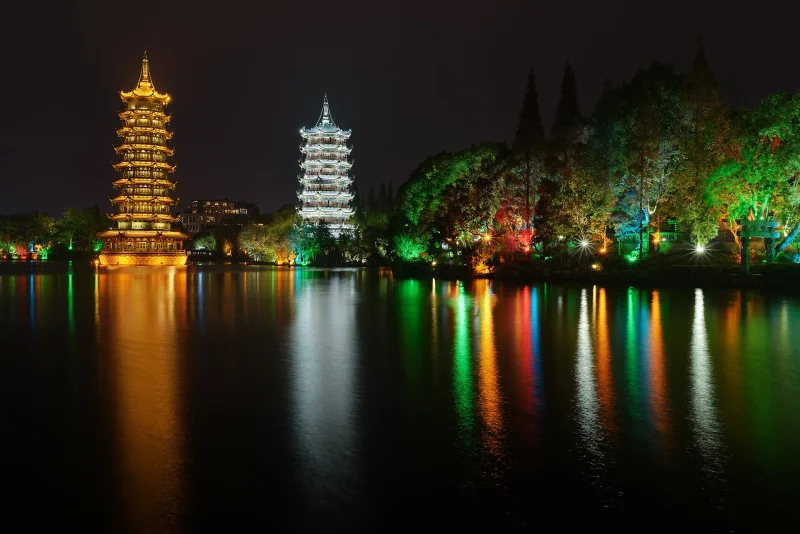
Guilin is a very different night-view city from China's tower-heavy skylines. The best evening scenes come from water, karst silhouettes, lit pavilions, and landmarks reflected in calm lakes. This guide focuses on Elephant Hill, the Two Rivers and Four Lakes route, Sun and Moon Pagodas, Ronghu Lake, waterside pavilions, and short street walks that work well after dinner.
Why Guilin Works After Dark
Guilin's night scenery is not only about brightness. It is about how small areas of light sit against dark hills and water. Elephant Hill becomes more sculptural at night, Sun and Moon Pagodas turn Shanhu Lake into a clear reflection scene, and the Two Rivers and Four Lakes system links several short walks into one compact evening route.
If you like water reflections, Guilin connects naturally with the slower mood of the Hangzhou West Lake night view route. If you prefer a canal-and-lantern feeling, compare it with the Suzhou ancient town canal night walk. Guilin is different because the karst hills make the water scenes feel more vertical and enclosed.
Start With Sun And Moon Pagodas
Sun and Moon Pagodas are the easiest first stop for Guilin night view photos. The gold and silver towers stand in Shanhu Lake, so even a simple composition can include architecture, water, reflection, trees, and a dark skyline. This is the place to start if you only have one short evening in the city.
The scene is strongest from across the water, where both pagodas can sit in the same frame. A phone can handle the subject well if you tap to expose for the towers instead of the black sky. With a camera, use a stable ledge or tripod if permitted and keep the shutter long enough for clean reflections.
Elephant Hill At Night
Elephant Hill is Guilin's best-known natural landmark, and night lighting makes the arch and cliff line easier to read from across the water. The rock shape, riverside path, and reflected lights make the scene feel different from a daytime postcard. It is also a useful reminder that Guilin's city center is built around rivers and hills rather than a single skyline wall.
For photos, stand far enough away to keep the full hill profile in the frame. If the air is hazy, focus on the lit arch and water reflection instead of trying to show distant details. A few people near the railing can help with scale, but the hill should remain the subject.
Two Rivers And Four Lakes Route
The Two Rivers and Four Lakes route links Li River, Taohua River, Ronghu Lake, Shanhu Lake, Guihu Lake, and Mulong Lake through the downtown water system. VisitGuilin describes the cruise as one of the city's popular night activities, especially around Ronghu, Mulong, Shanhu, and Guihu lakes. Even if you do not take a boat, the walking sections around the lakes are useful for calm evening photos.
A cruise gives you moving angles and lets you see bridges, banks, trees, and lit buildings from the water. A walk gives you more control over timing and composition. For a first visit, choose one mode instead of trying to do both quickly.
Ronghu Lake And Pavilions
Ronghu Lake is a good counterpoint to the pagodas because it feels quieter and more garden-like. The lakeside corridors, pavilions, bridges, and tree reflections make softer images than the bright twin towers. This section is useful when you want a more traditional Chinese garden atmosphere in the same evening route.
Look for layered compositions: a pavilion in the foreground, a dark hill or tree line behind it, and water reflections below. The best frames are often slightly off-center, because the walkways and railings can lead the eye into the scene.
Pedestrian Streets After The Lake Walk
After the water route, Guilin's pedestrian streets add a human layer: shop signs, food stalls, small restaurants, and people moving between lakefront and hotel areas. This is not the main scenic attraction, but it makes the guide feel complete. It shows how the night route connects to normal city life after the lights and reflections.
For street photos, use storefront light and avoid flash. Shoot from the side of the walkway, include signs only when they help establish place, and keep the scene natural. A short street section is enough; the core of this guide should stay with the water and landmark views.
Best Time For Photos
Blue hour is the most balanced time for Guilin, especially around the lakes. The sky has not gone fully black, the water still has detail, and the illuminated towers or pavilions are already visible. Later at night, focus on tighter compositions with reflections, lanterns, bridge lights, or street scenes.
Rain or wet pavement can help street photos, but heavy rain makes lakeside paths slippery and can blur distant hill outlines. If the evening is humid, work with closer subjects such as Elephant Hill's lit arch, the pagodas, and pavilions rather than trying to force a broad skyline.
Suggested First-Evening Route
A compact route starts with Sun and Moon Pagodas, continues along Shanhu and Ronghu Lake, adds Elephant Hill if time and access fit your plan, and finishes with a short pedestrian-street walk. If you take the cruise, treat it as the main activity and keep the walking portion lighter.
The goal is not to collect every bridge and lake in one night. The strongest Guilin night view set usually combines one bright landmark, one natural karst-water scene, one quieter pavilion reflection, and one small street section.
Planning Notes
For background route planning, the VisitGuilin Two Rivers and Four Lakes Cruise page summarizes the city water route, while the Riyue Shuangta Cultural Park page covers Sun and Moon Pagodas. Check current local notices for cruise schedules, park access, weather, and lighting arrangements before you go, especially around holidays or after heavy rain.
Image Credits
Images in this guide are credited to King of Hearts, N509FZ, and Gerd Eichmann via Wikimedia Commons under their listed Creative Commons license terms. Each photo was selected for direct relevance to Guilin, Elephant Hill, Li River, Shanhu Lake, Ronghu Lake, Sun and Moon Pagodas, pavilions, pedestrian streets, or the Two Rivers and Four Lakes night-route context.