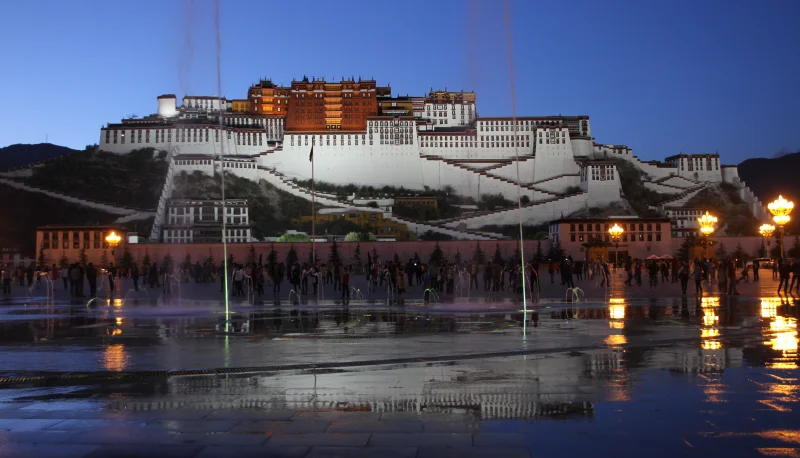
Lhasa's night views are built around a small number of very strong scenes: the Potala Palace after the floodlights come on, the darker roofline views from nearby streets, and the warm movement of people around Barkhor after sunset.
This guide focuses on Potala Palace, Barkhor, and nearby evening city lights. The route has a quieter rhythm than the neon-heavy skyline pages; for another plateau-city comparison, see Xining's mosque, station, and night-market route, while Lanzhou's Yellow River night guide gives a riverfront northwest contrast.
Best Areas After Dark
Potala Palace is the anchor. From the front plaza, the illuminated white and red walls stand out against the dark hillside, and the water or polished pavement in front can add reflections when the conditions are right.
Close and side angles change the mood quickly. A blue-hour frame keeps more sky color and architectural detail, while a later night frame makes the palace appear almost suspended above the surrounding trees and lower buildings.
Barkhor adds the human-scale layer. Night crowds, lamps, shopfront glow, and narrow-street shadows make the area feel very different from the open palace plaza, especially during festival evenings or busy walking hours.
Photo Route
Start near the Potala Palace plaza before the sky turns fully black. This is the best time for a balanced wide shot, because the palace lights are visible but the sky still keeps a little depth.
After that, move to a side or rooftop-adjacent viewpoint if available. These angles are useful for showing the palace above the city rather than only as a front-facing landmark.
End around Barkhor when the street lights and walking crowds are stronger. Keep the camera steady and look for layered scenes: lamps in the foreground, people moving through the middle of the frame, and darker walls or shopfronts behind them.
Timing and Practical Notes
The most useful window is from blue hour through the first two hours after dark. Later in the evening, the brightest palace lights can overwhelm phone cameras, so tap to expose for the lit walls and check that the highlights still have detail.
Because many scenes are dark and contrasty, a small tripod or stable railing helps. Around Barkhor, keep the setup compact, avoid blocking walkers, and wait for natural gaps instead of trying to stop foot traffic.
What to Photograph
A complete Lhasa night set should include one palace-wide frame, one reflection or plaza angle, one side view, one tighter illuminated-wall detail, and at least one Barkhor street scene. That mix keeps the gallery from becoming only a single facade and shows how the city feels after dark.