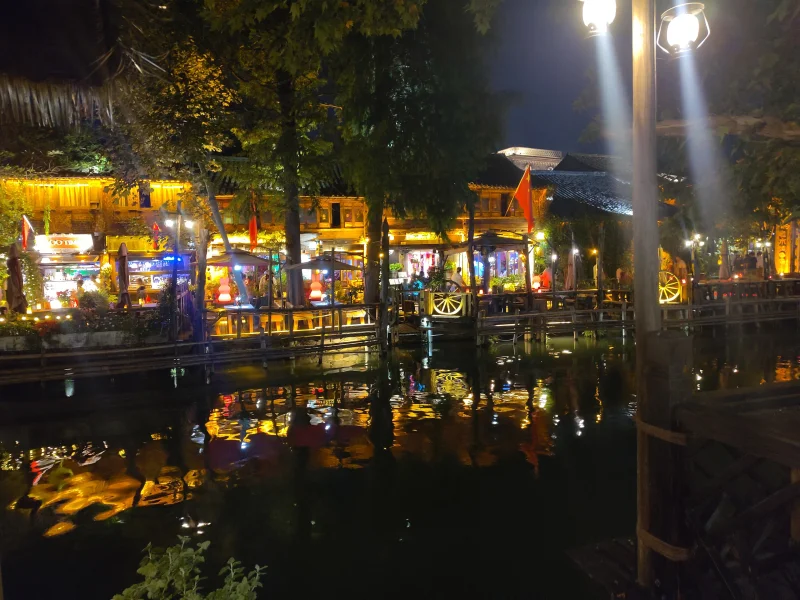
Jiaxing's best-known water-town evenings are found in Xitang and Wuzhen, where low bridges, timber-fronted houses, and canal boats look entirely different after the surrounding streets begin to dim. Both are within the wider Jiaxing area, but they work better as separate night walks than as a rushed single-evening itinerary.
Xitang is the quieter choice for a canal-side pause, with covered waterside passages and small boat views near the older lanes. Wuzhen, especially around Xizha, feels more composed after dark, with rows of lit houses and boats moving between reflections. For a larger-city canal comparison, Suzhou's evening canal walk has a more urban rhythm, while Lijiang Old Town offers a mountain-town contrast.
Xitang: bridges, boats, and covered waterside lanes
In Xitang, start with a slow circuit along the canals rather than following only the main visitor street. The strongest views come when a bridge frames the water, a passing boat breaks the reflection, or a line of lanterns runs beneath the eaves. Tawan Street and the small bridges near the waterways are useful reference points, but the most memorable photos often come from a quieter bend just away from the busiest clusters.
Look both directions from a bridge before taking a photograph. One side may hold a direct view of lit facades, while the other gives more space for dark water and reflected color. The covered walkways are practical in light rain and also create a good foreground when lanterns are visible beyond the wooden posts.
Wuzhen: a more theatrical canal night
Wuzhen's night scenes are broader and brighter, with housefronts, low railings, and boats arranged along the canal edges. Xizha is particularly rewarding once the immediate dinner crowd has moved on: the lights remain, but the water becomes easier to read in the frame. A high bridge or a clear opening beside the canal gives the best chance of seeing the rooflines and boats together.
Do not try to force the same composition in both towns. Xitang works well for smaller details such as a single boat, bridge arch, or covered lane. Wuzhen is better for wider reflections and repeating rooflines. Treating them as separate visual experiences keeps the evening walk more relaxed and the photos more varied.
Practical notes for a water-town night walk
Arrive before dark to understand the route, then stay through the first hour of illumination when the sky still has some color. Stone paths and bridges can be uneven or slippery after rain, so shoes with grip matter more than camera gear. Keep to public paths, avoid stopping in the center of narrow bridges, and give residents and shopfronts space in quieter stretches.
For handheld photos, use railings or bridge edges for stability and expose for the lanterns rather than the black sky. A shorter lens can include water and rooflines together; a longer focal length is useful when a boat passes through a brighter section of the canal. The goal is not to photograph every bridge, but to let each town's light, water, and scale set the pace.