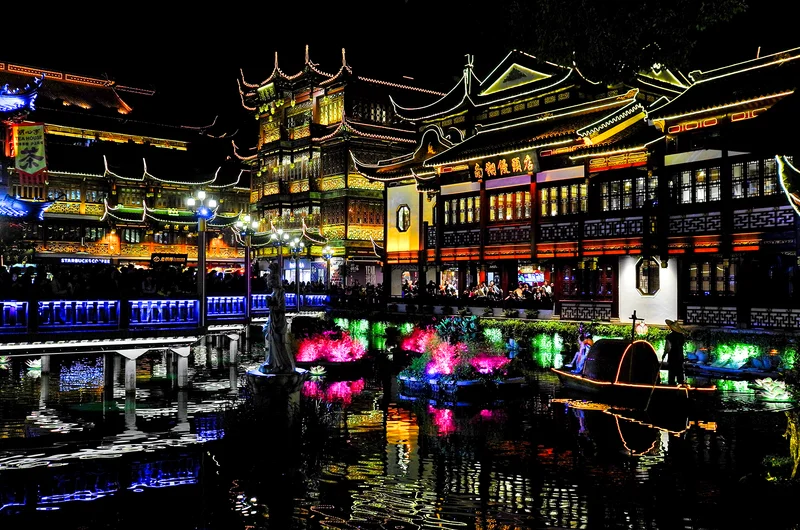
Shanghai's old city changes character when the rooflines around Yuyuan Bazaar begin to glow. Instead of the distant towers and broad river views of the Bund, the scene is close and layered: upturned eaves above busy lanes, illuminated shopfronts, and reflections around the pond beside Huxin Pavilion. It is an evening for walking slowly and looking upward as often as ahead.
This route stays around Yuyuan Tourist Mart, the Jiuqu Bridge area and nearby old-city streets in Huangpu district. Allow roughly two hours as a planning estimate, longer if you sit down for dinner or book a separate garden visit. The photographs show different years and seasons; decorative installations, shopfronts and lighting can change.
Know which part of Yuyuan you are visiting
The name Yuyuan is used loosely for several neighboring places. Yuyuan Bazaar, also called Yuyuan Tourist Mart or Yuyuan Garden Malls, is the shopping and dining area with the brightly outlined traditional-style buildings. The classical Yu Garden is a separate attraction with its own admission arrangements. The City God Temple is another distinct site nearby. An evening in the surrounding lanes does not automatically include entry into either attraction.
For an easy first visit, make the bazaar and pond your main destination. If the classical garden is important to you, check its current daytime and night-tour arrangements separately. Shanghai's official visitor information describes a ticketed garden night-tour program with reserved entry slots. Availability and opening nights depend on the current program; a photograph of a lit garden is not evidence that you can walk in at any hour.
Begin with the illuminated bazaar rooflines
Approach the commercial lanes around Middle Fangbang Road and let the buildings provide your first orientation. Before entering the busiest passage, step to one side where you can see a complete roofline. The warm outlines make a strong subject against the remaining blue in the sky, while the darker timber-colored facades supply depth below.
For a wide photograph, include one foreground element such as a doorway, lantern or a small group of walkers. A frame filled only with glowing lines can flatten the architecture. Keep the camera level when possible; if you tilt sharply upward, the buildings will appear to lean. On a phone, the normal lens often gives cleaner detail than a very wide lens in these darker lanes.
Walk toward Jiuqu Bridge and Huxin Pavilion
The pond around Jiuqu Bridge, the Zigzag Bridge, creates a different kind of view. Here the water breaks up the architecture into reflections, and the angles of the bridge lead the eye toward Huxin Pavilion. Work from a safe public edge of the pond rather than stopping in the narrow crossing. A slightly off-center viewpoint often separates the pavilion from the buildings behind it more clearly than a straight-on view.
Huxin Pavilion reopened in 2025 following protective restoration, according to Shanghai's official visitor service. Its present appearance and interior arrangements may therefore differ from older photographs. Treat it as a landmark first; check current tea service, entry and seating arrangements if you want to go inside. Exterior lighting does not guarantee that the interior is open.
The bridge can become a moving queue on busy evenings. If staff direct a one-way flow or limit access, follow that route and take your pond pictures from another available edge. Waiting for a small gap is more effective than trying to create an empty scene in the middle of a crowded crossing.
Continue into the surrounding lanes
After the pond, return to the commercial streets and look for smaller scenes: signs beneath deep eaves, the junction between two lanes, or a shop window lighting the pavement. These details give the walk variety without requiring a long transfer. Keep Fangbang Middle Road and Yuyuan Old Street saved on your map so you can find your way back when the lanes become busy.
Leave time for food rather than treating every stop as a photograph. Soup dumplings, snacks and tea are part of the area's appeal, but menus, queues and serving times vary by business. Check the displayed price and whether seating is included before ordering. Ask before making close photographs of staff or diners, and keep clear of doorways while people are collecting food.
Choose ordinary evenings or a seasonal event
An ordinary evening emphasizes architecture, reflections and street life. Seasonal celebrations can add large lantern sculptures, themed decorations, performances and special crowd-control routes. They also change what you can photograph: a clear view of the pond on one visit may be occupied by an installation on another.
Do not plan around a lantern sculpture seen in an old photograph without checking the event dates. The annual lantern season and other cultural programs have their own schedules, admission rules and access zones. This guide's older festival photographs illustrate the area's seasonal character, rather than promise a particular display on your travel date. Look up the current Yuyuan Tourist Mart announcements before a festival visit and allow extra time for entry.
Take sharper night photographs without blocking the walk
Arrive before full darkness if you want color in the sky. Begin with the widest scene, then move closer to roof details and reflections as the sky darkens. Reduce exposure slightly when bright edges lose their color; recovering shadow detail later is usually easier than recovering a completely white light strip.
For handheld pictures, brace your elbows, pause your movement and take several frames so you can choose the sharpest. A phone's night mode works well for buildings but can blur people who are walking. Use a shorter exposure for street scenes and save longer exposures for relatively still subjects. Keep a tripod folded in narrow lanes and crowded bridge approaches; use one only where space and local rules allow.
Rain can create appealing pavement reflections, but wet paving and bridge surfaces require care. Clean the lens after moving from an air-conditioned room into humid weather, and check a photograph at full size before leaving a viewpoint. A bright screen can disguise soft focus.
Plan the journey and an optional Bund extension
Yuyuan Garden station is served by Metro lines 10 and 14. Follow the current station signs toward the tourist area and check the last train for your destination before starting the walk. Exit access and pedestrian routes may change during large events. Save your accommodation address in Chinese, and arrange a taxi pickup on a vehicle-accessible road rather than inside the pedestrian lanes.
If you still have energy after the bazaar, continue toward the Huangpu waterfront using a live map and legal crossings. Allow a separate block of time rather than assuming the river is just outside the pond area. Our Bund and Lujiazui night-view guide helps you choose a river viewpoint once you arrive. For another evening built around waterside historic streets, Suzhou's canal night walk offers a useful contrast to Shanghai's denser shopping lanes.
A relaxed evening route
Start near the bazaar before sunset, take one broad roofline photograph, then walk toward the pond as the lights become more visible. Circle only the accessible public edges, cross Jiuqu Bridge if the queue is comfortable, and return through the lanes for food. Finish with a final look upward at the eaves before heading to the metro or choosing the waterfront extension.
On a crowded night, shorten the route instead of trying to photograph every corner. The best keepsake may be one sharp pavilion reflection and one lively street scene. Leave the ticketed garden, a longer meal or the Bund for another evening if adding them would make the visit feel rushed.
Visitor information
- International Services Shanghai: Yuyuan Bazaar
- International Services Shanghai: Huxin Pavilion restoration and garden night tours
- International Services Shanghai: metro access to Yuyuan
Photo credits
Photographs show different years and seasons. Decorations, lighting and shopfronts may differ during your visit. Images resized for display; Commons photographs retain their linked licenses.
- Illuminated Yuyuan Bazaar buildings and pond reflections in October 2019: Windmemories, CC BY-SA 4.0.
- Yuyuan Bazaar shopping street with illuminated rooflines at night: MiLu24, CC BY-SA 3.0.
- Layered traditional-style rooflines in Yuyuan Bazaar at night: Marek Śliwecki, CC BY-SA 4.0.
- Old-city entrance arch beside Yuyuan Tourist Mart after dark: MiLu24, CC BY-SA 3.0.
- Brightly outlined commercial building at the edge of Yuyuan Bazaar: MiLu24, CC BY-SA 3.0.
- Jiuqu Bridge leading toward the illuminated Huxin Pavilion in 2009: Goki (talk), CC BY-SA 3.0.
- Huxin Pavilion with colored lighting reflected in the pond in October 2019: Windmemories, CC BY-SA 4.0.
- Gold and red rooflines above a narrow Yuyuan Old Street passage at night: Nadine K, Pexels License.
- Upturned eaves and illuminated architectural details in Yuyuan Bazaar: Guillaume Kremer, Pexels License.
- Seasonal illuminated decoration above a Yuyuan Bazaar lane on an earlier visit: Vind, Pexels License.