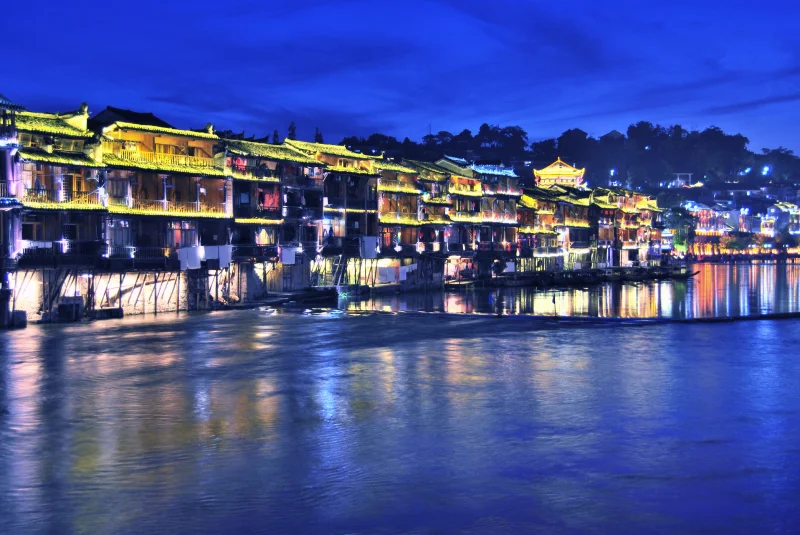
The Tuojiang River gives Fenghuang Ancient Town its evening shape. Lit balconies line the water, covered bridges draw the eye across it, and the reflections keep changing as people and boats move through the scene. For a first visit, plan a riverside walk with time to cross to the opposite bank, rather than heading straight to one photograph spot and leaving.
Build the evening around the river, not a long attraction list
Fenghuang is in western Hunan's Xiangxi region. Its riverfront stilted buildings, often called diaojiaolou, are a central part of the town's character, alongside the cultural traditions of its Miao and Tujia communities. The Hunan government's introduction to Fenghuang is a useful starting point for the town's background.
Allow an unhurried evening for the river itself. Start around Hongqiao, explore an accessible stretch of bank, cross by an open pedestrian route and return with the buildings facing you from a different angle. Add dinner as a pause rather than treating it as a separate trip across town. Save house museums and other indoor sights for their own visiting hours.
Arrive before full darkness
The short period after sunset can retain detail in tiled roofs and the hills behind the town while the building lights begin to stand out. Arriving early also lets you check steps, crossings and the route back before they become harder to read. There is no single year-round clock time for this: sunset, weather and the current lighting arrangements all matter.
Take one wider river photograph first. Once the sky darkens, move closer to a balcony, bridge opening or reflection instead of trying to make every frame a panorama. The photographs on this page come from earlier visits; shopfronts, decorative lighting and riverside access may look different on your trip.
Hongqiao: look from the bank as well as the bridge
Hongqiao, also known as Rainbow Bridge, provides a recognizable landmark for orienting yourself. From the bank, you can place its covered structure above the river and include the water below. On or near a crossing, the view opens along the river instead. These two perspectives tell different stories even when taken only a short walk apart.
Choose a position with space for other visitors to pass. A bridge is a useful crossing before it is a camera platform, so avoid stopping in its narrowest passage. If a particular deck or viewing area is closed, use the public riverbank rather than assuming the photograph can be recreated from the same spot.
Make the stilted buildings the subject
The riverfront houses are most interesting when you can see how their lower supports, balconies and roofs fit together. Look across the water for a row with a clear outline, then leave enough dark water beneath it to show the reflection. A tighter frame can reveal the rhythm of timber posts that disappears in a much wider view.
The waterfront is also a working visitor district with restaurants, bars and guesthouses. Music, signs and people are part of the evening, so do not expect every bank to be quiet. For a calmer composition, walk until the lights separate into individual buildings rather than filling the entire frame with signs.
Cross once and let the return walk change the view
It is easy to keep following the same bank and collect almost identical photographs. An open bridge crossing changes the angle of the waterfront, the reflections and the foreground. On the return leg, look for one feature you did not notice before: a roof behind a bridge, a dark gap between buildings or a row of reflections beneath the balconies.
Low crossings and waterside steps require care, especially after rain or when the river is high. Follow local closures and stay on open routes. Stepping stones are not essential to an evening walk, and a longer route over an open bridge is preferable when footing or visibility is uncertain.
Choose between a boat ride and more time on foot
A boat gives a lower, moving view of the waterfront; walking lets you stop, wait for a clear view and revisit a composition. Neither is necessary for the other. If you want a night boat ride, check the operating pier, last departure, route and ticket inclusions locally before committing your evening to it.
Boat movement also changes the photography. A long night-mode exposure that works on a stationary bank may blur on the water. Use a shorter exposure where possible, keep the camera steady and enjoy the ride even if it does not produce the same crisp reflections as a shore-based photograph.
A simple approach to photographing the lights
On a phone, tap a lit building and reduce the exposure if windows and roof lighting turn into featureless white patches. Keep both hands steady and avoid heavy digital zoom. For a camera, a supported longer exposure can smooth the river, while a shorter exposure preserves ripples and passing visitors. Put a tripod only where it leaves the walkway clear.
Build a small sequence instead of repeating the same view: an overall river scene, a bridge, a close row of balconies, a reflection and a street-level detail. Ask before photographing people closely, particularly where someone is posing for a paid portrait session.
Plan the arrival and the journey back
Fenghuang Gucheng railway station is not the old riverfront. Allow for an onward transfer and check where your accommodation can meet you if its lane is pedestrian-only. The official Fenghuang maglev guide describes the sightseeing connection between the railway station area and the ancient town; verify current operating hours against your train time. Keep your accommodation's Chinese address available and arrange the return before staying late by the river.
If the rest of your Hunan trip takes you to the provincial capital, Changsha's Xiang River night views offer a broader urban waterfront. For another old-town evening on a future trip, Lijiang's lantern streets and canals invite a closer look at lanes and smaller waterways.
Photo credits
Photographs resized for display.
- Fenghuang stilted waterfront buildings at blue hour: 蒋仕恒, CC BY-SA 3.0.
- Illuminated river weir and bridge beside Fenghuang waterfront: liuzr99, CC BY-SA 2.0.
- Lit balconies and visitors along the Tuojiang riverbank: liuzr99, CC BY-SA 2.0.
- Layered tiled roofs and their reflections across the Tuojiang: liuzr99, CC BY-SA 2.0.
- Fenghuang riverfront framed beneath an illuminated bridge: liuzr99, CC BY-SA 2.0.
- A blue-lit bridge above the curved Tuojiang promenade: liuzr99, CC BY-SA 2.0.
- Symmetrical bridge reflections on the Tuojiang at night: liuzr99, CC BY-SA 2.0.
- Lantern and riverside railing beside a lit low crossing: liuzr99, CC BY-SA 2.0.
- Visitors on a low crossing below Fenghuang riverside houses: liuzr99, CC BY-SA 2.0.
- Elevated night view over Fenghuang rooftops and the river: Sunyiming, CC BY-SA 4.0.