Why go at night
Beijing night views are different from riverfront skyline cities. The strongest scenes come from illuminated historic gates, moat reflections, modern cultural buildings, and warm street lights in older neighborhoods. A first evening in Beijing works best when visitors combine one major landmark view with one slower street section.
Start with Tiananmen and the central landmarks
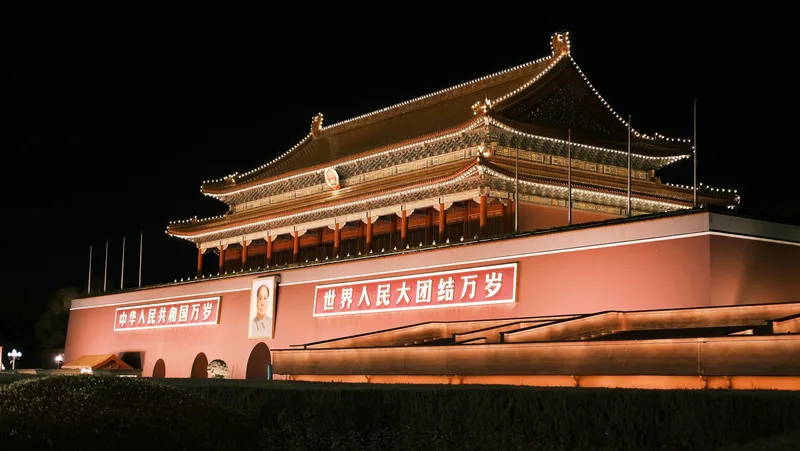
Tiananmen is the visual anchor for many first-time visitors. At night, the gate becomes a broad, low-lit landmark rather than a tall skyline subject. Keep the plan flexible because security checks, access rules, crowd controls, and special event arrangements can change. Use the surrounding area for exterior night photos only after confirming current access locally.
Add Forbidden City moat views
The Forbidden City is not just an interior museum visit. Around the moat and corner towers, the water can turn a simple night photo into a layered view with walls, rooflines, trees, and reflections. Blue hour is especially useful because the sky still separates the architecture from the dark background.
Modern Beijing after dark
For a more contemporary contrast, add the National Centre for the Performing Arts or Olympic Park lights on a separate evening. The National Centre works well because its curved surface and water reflection are easy to photograph. Olympic Park is broader and more open, better for wide compositions and city-light reflections.
Old streets and hutong atmosphere
Beijing's older streets are useful after the main landmark photos are done. Look for shopfront light, narrow lanes, brick walls, bicycles, and small restaurants instead of only famous monuments. Keep the camera small and avoid blocking narrow lanes, doorways, or shop entrances.
Best photo approach
Use a simple sequence: one wide landmark view, one reflection angle, and one street-detail image. This keeps the night from becoming a rushed checklist. For gates and towers, stand far enough back to include rooflines and foreground space. For hutong or shopping streets, use warm light from windows and signs as the main subject.
How it compares
Beijing feels more ceremonial and historic than Shanghai's river skyline. If you want a classic modern skyline after this, compare it with the Shanghai Bund and Lujiazui guide. If you prefer another historic-light route with city walls and towers, the Xi'an City Wall and Bell Tower guide is a natural follow-up.
Practical tips
Plan shorter distances than the map suggests because security checks, large crossings, crowds, and closed areas can slow movement at night. Bring a compact camera or phone, keep identification and travel documents accessible, and confirm current opening, reservation, and access rules before planning around a specific landmark.
Planning references
For background context, see the UNESCO page for Beijing Central Axis, the Palace Museum official site, and the National Centre for the Performing Arts official site.
Photo: Serena Xu / Pexels / Pexels License. Photo: Zhang Kaiyv / Pexels / Pexels License. Photo: Zhenming Wang / Pexels / Pexels License. Photo: Zhang Kaiyv / Pexels / Pexels License. Photo: Zhang Kaiyv / Pexels / Pexels License. Photo: Zhang Kaiyv / Pexels / Pexels License. Photo: David Yu / Pexels / Pexels License. Photo: Zhang Kaiyv / Pexels / Pexels License.